About this Pacing Guide:
The information in this document is organized by theme created in partnership with several other states in our network. It is designed to be used as a STARTING POINT for designing a high school semester course. The yellow column highlights the units for teachers who are implementing the Stock Market Game alongside the themes.
The following tables list lessons available through the Kansas Council on Economic Education and the programs associated with KCEE. Teachers are NOT expected to teach all of these lessons in a semester course but this gives lots of options to find favorites. Some lessons integrate technology and some are standalone lessons from network curriculum books. If using the Stock Market Game, you will need to register your classes each semester to have access to those lessons but there is no cost to participate as long as you have at least 2-3 students on a team. Register online at www.stockmarketgame.org. Free trainings are offered online. Have questions? Email us kcee@wichita.edu.
Many of the links direct to EconEdLink. Note that this resource-filled website is constantly being updated. Lessons can be sourced in a variety of ways – by keyword, topic, standard, and grade level. You can find an intro here How to use EconEdLink.org
To receive access to all of the resources noted below without links, please attend our Financial Literacy Workshops.
ABOUT KANSAS STANDARDS: The Kansas State Department of Education has adopted the National Standards in Personal Financial Literacy which were developed by the Council for Economic Education and the Jump$tart Coalition for Personal Financial Literacy. (See more on Kansas Standards)
The columns below are examples of what you will see for each theme. The text below the column title will tell you a little about that column. Please take a few minutes to read the information below. Please note that in EconEdLink, each lesson’s correlated Financial Literacy standard(s) can be found under the “Standards” header.
A great way to reinforce your students’ knowledge of Financial Literacy is through the Personal Finance Challenge, a fun and motivating team competition that provides high school students the opportunity to get financially savvy and demonstrate their money management skills in the six knowledge areas of personal finance: earning income, spending, saving, investing, managing credit, and managing risk. Learn more at https://financechallenge.unl.edu/Kansas/Welcome
| Personal Finance Concepts / Standards | Council for Economic Education Lessons (most from Virtual Economics*) | Other Lessons | Simulations / Videos |
| This column lists the national personal finance standard (adopted by Kansas) addressed in that theme. | Lessons in this column come from resources published by the Council for Economic Education. The newest publication is the 3rd Edition of the Financial Fitness for Life 9-12. Virtual Economics, available on a thumb drive, is in transition and new copies currently are not available. If you have issues accessing any of these materials, contact KCEE for assistance. | These are FREE lessons that come from our network website EconEdLink or one of our program sites such as LifeSmarts. | These videos are free resources available to Kansas teachers through our network. The Kansas Stock Market Game fees have been sponsored for Kansas schools. Contact KCEE for training and how to access the free lessons. |
Semester Plan:
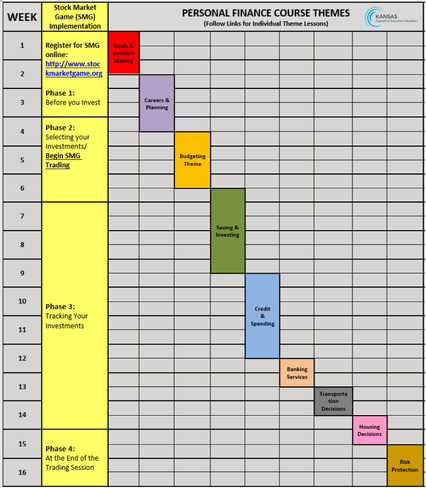
KCEE recommends including both the Stock Market Game (SMG) ™ and the Personal Finance Challenge student programs into your financial literacy curriculum. This table outlines SMG curriculum, available in the game’s Teacher Support Center, that enhances the corresponding financial literacy lessons.
| Week | Stock Market Game Phase | Course Content Section |
| 1 | 1: Before You Invest | Goals & Decision Making |
| 2 | 1: Before You Invest | Finish Goals & Decision Making, Start Careers & Planning |
| 3 | 1: Before You Invest | Continue Careers & Planning |
| 4 | 2: Selecting Your Investments & Begin Trading | Finish Careers & Planning, Start Budgeting Theme |
| 5 | 2: Selecting Your Investments & Begin Trading | Continue Budgeting Theme |
| 6 | 2: Selecting Your Investments & Begin Trading | Finish Budgeting Theme, Start Saving & Investing |
| 7 | 3: Tracking Your Investments | Continue Saving & Investing |
| 8 | 3: Tracking Your Investments | Continue Saving & Investing |
| 9 | 3: Tracking Your Investments | Finish Saving & Investing, Start Credit & Spending |
| 10 | 3: Tracking Your Investments | Continue Credit & Spending |
| 11 | 3: Tracking Your Investments | Continue Credit & Spending |
| 12 | 3: Tracking Your Investments | Finish Credit & Spending, Start Banking Services |
| 13 | 3: Tracking Your Investments | Finish Banking Services, Start Transportation Decisions |
| 14 | 3: Tracking Your Investments | Finish Transportation Decisions, Start Housing Decisions |
| 15 | 4: At The End of The Trading Sesson | Finish Housing Decisions, Start Risk Protection |
| 16 | 4: At The End of The Trading Sesson | Finish Risk Protection |
Goals & Decision Making:
Standard: Decision-making concepts are threaded throughout the national standards.
| Personal Finance Concepts / Standards | Council for Economic Education Lessons (most from Virtual Economics*) | Other Lessons | Simulations / Videos |
| Recognize the responsibilities associated with personal financial decisions. | > How to Become a Millionaire * Financial Fitness for Life 9-12: Theme 1, Lesson 1 > The Economic Way of Thinking *NEW EDITION Financial Fitness for Life 9-12: Theme 1, Lesson 2 > Decision Making *NEW EDITION Financial Fitness for Life 9-12: Theme 1, Lesson 3 > What’s the Cost of Spending & Saving *NEW EDITION Financial Fitness for Life 9-12, Lesson 20 > Why Save? Learning, Earning & Investing for a New Generation, Lesson 1 > Invest in Yourself Learning, Earning & Investing for a New Generation, Lesson 2 > Building Wealth over the Long Term Learning, Earning & Investing for a New Generation, Lesson 9 > Credit: Your Best Friend or Your Worst Enemy Learning, Earning & Investing for a New Generation, Lesson 12 > Why Not Save? Learning, Earning & Investing for a New Generation, Lesson 13 > The Role of Government in Financial Markets Learning, Earning & Investing for a New Generation, Lesson 15 > Making Choices About Saving & Investing Capstone: Unit 3, Lesson 16 | > Ten Things about Money Lesson > Opportunity Cost > Utility-Can Happiness be Measured? > Using Slope to Compute Opportunity Cost > What Car Should I Buy? > Education: Weigh Your Options > How Will I Pay for College > The Basics of Saving and Budgeting > Creating a Financial Safety Net > Buying a Home > Owning a Car > LifeSmarts Resources by Topic > Decision Making – LifeSmarts U | > How Rapper 50 Cent Made Millions and Then Lost it Webinar > Let’s Talk about Money > Compound Interest Calculator > Decision Making/Cost-Benefit Analysis Concept Video > Incentives Concept Video > Opportunity Cost Concept Video > Scarcity Concept Video > You’re Going to College > Scholarship Scams Podcast > Lights, Camera, Budget! Activity |
| Use reliable resources when making financial decisions. | > Making Credit Choices *NEW EDITION Financial Fitness for Life 9-12: Theme 4, Lesson 12 > Finding Financial Information Online Learning, Earning & Investing for a New Generation, Lesson 4 > What Are Stock Markets? Learning, Earning & Investing for a New Generation, Lesson 7 > Researching Companies Learning, Earning & Investing for a New Generation, Lesson 11 > The Stock Market and the Economy: Can You Forecast the Future? Learning, Earning & Investing for a New Generation, Lesson 16 > The Language of Financial Markets Learning, Earning & Investing for a New Generation, Lesson 20 | > Mobile Phones Matter > Cybersecurity and Economics: Evaluating Websites > Staying Afloat Financially in the 21st Century > Common Scams | > Shop Smart Online Podcast |
| Summarize major consumer protection laws. | > Consumer Credit Protection *NEW EDITION Financial Fitness for Life 9-12, Lesson 18 > Scams and Schemes Financial Fitness for Life 9-12: Theme 4, Lesson 19 | > Satisfaction Please! > Consumer Rights > Deceptive Advertising: Crossing the Line | > How to Complain |
| Make criterion-based financial decisions by systematically considering alternatives and consequences. | > How to Become a Millionaire *NEW EDITION Financial Fitness for Life 9-12: Theme 1, Lesson 1 > Uncle Sam Takes a Bite *NEW EDITION Financial Fitness for Life 9-12: Theme 2, Lesson 7 > Choosing a Career *NEW EDITION Financial Fitness for Life 9-12, Lesson 4 > Making Credit Choices *NEW EDITION Financial Fitness for Life 9-12: Theme 4, Lesson 12 > Managing Your Money *NEW EDITION Financial Fitness for Life 9-12: Theme 3, Lesson 8 > What is a Bond? Learning, Earning & Investing for a New Generation, Lesson 5 > What is a Mutual Fund Learning, Earning & Investing for a New Generation, Lesson 6 > Building Wealth over the Long Term Learning, Earning & Investing for a New Generation, Lesson 9 > Researching Companies Learning, Earning & Investing for a New Generation, Lesson 11 > Credit: Your Best Friend or Your Worst Enemy Learning, Earning & Investing for a New Generation, Lesson 12 > Managing Risk Learning, Earning & Investing for a New Generation, Lesson 18 > Investing Internationally Learning, Earning & Investing for a New Generation, Lesson 19 > Planning Your Financial Future Learning, Earning & Investing for a New Generation, Lesson 21 > Water Resources Energy, Economics, and the Environment, Lesson, Unit 3- Activity #9 | > How to Use the Behavioral Economics Lessons > Behavioral Economics Lesson One: Introduction to Behavioral Economics > Behavioral Economics Lesson Two: The Anchoring Effect > Behavioral Economics Lesson Three; Loss Aversion, Endowment Effects, and Default Bias > Behavioral Economics Lesson Four: Why Are We So Impatient > Behavioral Economics Lesson Five: Other Things Matter > Cybersecurity & Economics: Social Media and You > College: Where am I going to go? > National Budget Simulation | > Behavioral Economics: How Emotions Impact Webinar |
| Apply communication strategies when discussing financial issues. | > What is Economic Justice? Teaching the Ethical Foundations of Economics, Lesson 10 > Lessons from History: Stock Market Crashes Learning, Earning & Investing for a New Generation, Lesson 16 | > Are the Best Things in Life Free? > Teaching Personal Finance with Empathy | > Family-At-Home Financial Fun Pack |
| Analyze the Requirement of contractual obligations. | > Do You Want an Extended Warranty with That? | ||
| Control personal information. | > Don’t Be Scammed * Financial Fitness for Life 9-12, Lesson 19 > Credit Management Capstone: Unit 3, Lesson 18 > Scams and Schemes Financial Fitness for Life 9-12: Theme 4, Lesson 19 | > Cybersecurity and Personal Finance: Identity Theft > Cybersecurity and Economics: Social Media and You > Cybersecurity and Economics: Evaluating Websites > Buying on Credit > Schemes Scams & Ploys Powerpoint & Notes PP | > Online Safety Podcast > Many more consumer videos |
| Other Resources | > Understanding Financial Markets, 2007-2009 Teaching Financial Crisis, Lesson 8 | > Economic Systems Concept Video |
Careers and Planning Theme
Standard: Earning Income
| Personal Finance Concepts / Standards | Council for Economic Education Lessons (most from Virtual Economics*) | Other Lessons | Simulations / Videos |
| Explore job and career options. | > Making Your Own Job *NEW EDITION Financial Fitness for Life 9-12: Theme 2, Lesson 5 > Choosing a Career *NEW EDITION Financial Fitness for Life 9-12, Lesson 4 > Paying for Post-Secondary Education *NEW EDITION Financial Fitness for Life 9-12, Lesson 16 > Looking for a Job Financial Fitness for Life 9-12, Theme 2: Lesson 4 > Why Some Jobs Pay More Than Others Financial Fitness for Life 9-12, Theme 2 Lesson 6 > Income and Choices Your Credit Counts Section 1 > Invest In Yourself Learning, Earning & Investing for a New Generation, #2 > Why Do Some People Earn More Than Others? Capstone, Lesson 15 > The Knowledge and Technology-Based Economy of Today Focus: Understanding Econ in US History, Lesson 38 > Income Distribution High School Economics 3rd Edition > Borrowing Decisions and Expected Returns (Entrepreneur) Master Curriculum Guide: Economics & Entrepreneurship, Lesson 14 > What are you worth? Entrepreneurship Economics, #5 > The Entrepreneur and Human Capital Entrepreneurship Economics, Lesson 9 > The Business Plan Entrepreneurship Economics, Lesson 11 | > Do You Have a Yen to Go to College? >The 411 on College Education > Inflation and Unemployment – Is There a Correlation? > Investing in Yourself: Closing the Soft Skills Gap > How Will I Pay for College > The Hidden Costs of College > Education: Weigh Your Options > Invest in Yourself > Wages and Me > A Fair Wage > Business Ownership: The Franchise Option >‘Be All You Can Be’….For Minimum Wage? > Post-Secondary Education | > Finding the Right College Fit: How Inflation and Saving Affect Paying for College Webinar > Finding the Right College Fit: College and Credit – Navigating the College by Making Good Financial Decisions Webinar > Will a Robot Replace Your Job? > Inflation and Unemployment – Is There a Correlation Webinar > The Stock Market Game™ – Teacher Login Required > Human Capital and Labor Markets Series Concept Video > Productive Resources Concept Video > The Entrepreneur Video > Entrepreneurs |
| Compare sources of personal income and compensation. | > Making Your Own Job *NEW EDITION Financial Fitness for Life 9-12: Theme 2, Lesson 5 > Why Some Jobs Pay More Than Others Financial Fitness for Life 9-12, Theme 2 Lesson 6 > Invest In Yourself Learning, Earning & Investing for a New Generation, Lesson 2 | > Making Money – LifeSmarts U > The Benefits of Investing Early | > Who Decides Wage Rates > Income Distribution Concept |
| Analyze factors that affect net income. | > Uncle Sam Takes a Bite *NEW EDITION Financial Fitness for Life 9-12: Theme 2, Lesson 7 > Tax Math Mathematics & Economics, Lesson 13 > Taxes Change Behavior Focus: Understanding Economics in Civics & Government, Lesson 7 > The Role of Government: Who Needs it? Personal Decision Making | > Preparing Your Form 1040 > Exploring Taxes > A Fair Wage > Wages and Me > The Mathematics Behind Progressive, Regressive, and Proportional Taxes > Unemployment Data: Is the Economy Healthy? | SIMULATION: > Intro to Turbo Tax > Taxes and Income |
| Other Resources | > Who Decides Wage Rates? Video model of the lesson High School Economics 3rd Edition > Inflation High School Economics 3rd Edition > Migration Focus: Globalization, Lesson 8 > The Distribution of Income and Investments in Human Capital Focus: Institutions and Markets, Lesson 9 | > Distribution of Income > Immigration > Minimum Wage/The Challenge of Living on it > Income Inequality | > Economic Development Concept Video > Underpaid Millionaires? The Economics of Major League Baseball |
Budgeting Theme
Standard: Spending
| Personal Finance Concepts / Standards | Council for Economic Education Lessons (most from Virtual Economics*) | Other Lessons | Videos / Activities |
| Develop a plan for spending and saving. Spending | > What’s the Cost of Spending and Saving? *NEW EDITION Financial Fitness for Life 9-12: Theme 5, Lesson 20 > Managing Your Money *NEW EDITION Financial Fitness for Life 9-12: Theme 3, Lesson 8 > Paying for Post-Secondary Education *NEW EDITION Financial Fitness for Life 9-12, Lesson 16 > What’s the Cost of Spending & Saving *NEW EDITION Financial Fitness for Life 9-12, Lesson 20 > Creating and Using a Budget Capstone: Unit 3, Lesson 17 > Financial Planning: Budgeting Your Financial Resources Personal Decision Making, Lesson 6 > Making Choices About Saving & Investing Capstone: Unit 3, Lesson 16 > Powerball Economics Mathematics & Economics: Connections for Life 9-12 *SEE MORE IN THE SAVING & INVESTING THEME | > The Basics of Saving and Budgeting > Budgeting Basics > Creating a Financial Safety Net > Renting a Place to Live > Budgeting – LifeSmarts U > Budgeting (Math focus) > Staying Afloat Financially in the 21st Century | > SIMULATION: Budgeting for Income and Expenses > Comparing Savings Accounts > The Personal Finance Portfolio Webinar > Budget Odyssey Interactive > Money Management/Budgeting Concept Video > Managing Your Money Podcast, Companion Lesson Plan, Vocabulary List, & Vocabulary Prompts > Hands On Banking Budgeting and Spending Webinar > Hands on Banking You and Money Webinar |
| Develop a system for keeping and using financial records. Spending | > Banking Basics Financial Fitness for Life 9-12: Theme 3, Lesson 9 > Financial Institutions Your Credit Counts Challenge: Section 2 > The Instruments and Institutions of Modern Financial Markets Teaching Financial Crises, Lesson 7 | > Mobile Phones Matter | |
| Describe how to use different payment methods. Spending | > The Mathematics of Credit Card Interest and Fixed Payments Mathematics and Economics 9-12, Lesson 15 > Cash Flow and the Successful Entrepreneur Entrepreneurship in the U.S. Economy, Lesson 22 > Banking Basics Financial Fitness for Life 9-12: Theme 3, Lesson 9 | > Should I Use Cash or Credit? > Fact or Fake Out PowerPoint Consumer Resources & instructor notes | > Many timely videos |
| Apply consumer skills to purchase decisions. | > Decision Making *NEW EDITION Financial Fitness for Life 9-12: Theme 1, Lesson 3 > The Economic Way of Thinking *NEW EDITION Financial Fitness for Life 9-12: Theme 1, Lesson 2 > Managing Your Money *NEW EDITION Financial Fitness for Life 9-12: Theme 3, Lesson 8 *SEE MORE IN THE GOALS & DECISION MAKING THEME *SEE MORE ON RENTING / OWNING HOME IN HOUSING SECTION THEME *SEE MORE ON CAR PURCHASE IN TRANSPORTATION THEME | > Buying vs. Renting > Show Me The Money > The Early 1980’s: A Tough Time for Home Builders and Mortgage Bankers > Credit Reports and Credit Scores >Lessons for College Costs/Debt > Credit Reports | > Analyzing a Credit Report and Score |
| Use a personal financial plan. | > Managing Your Money *NEW EDITION Financial Fitness for Life 9-12: Theme 3, Lesson 8 >How to Become a Millionaire *NEW EDITION Financial Fitness for Life 9-12: Theme 1, Lesson 1 > Building Wealth over the Long Term Learning, Earning & Investing for a New Generation, Lesson 9 > Planning Your Financial Future Learning, Earning & Investing for a New Generation, #21 | > How Long is Your Life > Retirement Planning | > SIMULATION: Budgeting for Income and Expenses |
Saving and Investing Theme
Standards: Saving and Investing
| Personal Finance Concepts / Standards | Council for Economic Education Lessons (most from Virtual Economics*) | Other Lessons | Simulations / Videos |
| Develop a plan for saving. | > Financial Institutions and Services *NEW EDITION Financial Fitness for Life 9-12 Lesson 9 > Comparing Savings Accounts Simulation > What’s the Cost of Spending & Saving *NEW EDITION Financial Fitness for Life 9-12, Lesson 20 > Why Save Learning, Earning & Investing for a New Generation, Lesson 1 > Why Not Save? Learning, Earning & Investing for a New Generation, Lesson 13 > Planning Your Financial Future Learning, Earning & Investing for a New Generation, Lesson 21 > The Mathematics of Savings Mathematics & Economics 9-12, Lesson 14 > Making Choices About Saving & Investing Capstone: Unit 3, Lesson 16 > Cash or Annuity Mathematics & Economics 9-12, Lesson 11 > More lessons on saving can be found in the budgeting theme | > The Basics of Saving and Budgeting > A Penny Saved > Saving and Budgeting Using the Wheel of Mystfortune | > Comparing Savings Accounts > Interest Calculator > Saving and Investment Concept Video |
| Explain how investing builds wealth and helps meet financial goals. Saving | > How to Become a Millionaire *NEW EDITION Financial Fitness for Life 9-12 Theme 1, Lesson 1 > What’s the Cost of Spending and Saving? *NEW EDITION Financial Fitness for Life 9-12, Theme 5, Lesson 20 > Financial Management: Investing *NEW EDITION Financial Fitness for Life 9-12, Lesson 22 > Internet Tools and Investing Financial Fitness for Life 9-12: Theme 5, Lesson 22 > Why Save? (Compound Interest) Learning, Earning & Investing for a New Generation, Lesson 1 > What is a Mutual Fund Learning, Earning & Investing for a New Generation, Lesson 6 > Building Wealth over the Long Term Learning, Earning & Investing for a New Generation, Lesson 9 > Why Not Save? Learning, Earning & Investing for a New Generation, Lesson 13 > The Language of Financial Markets Learning, Earning & Investing for a New Generation, Lesson 20 > Planning Your Financial Future Learning, Earning & Investing for a New Generation, Lesson 21 | > Time Value of Money > The Benefits of Investing Early > Compound Interest > Stock Market Price History | > Recorded Webinar: Compound Interest > Compound Interest Calculator > Many relevant lessons can be found on the Teacher Support Center at stockmarketgame.org (account required) |
| Evaluate investment alternatives. Saving | > What’s the Cost of Spending and Saving? *NEW EDITION Financial Fitness for Life 9-12, Theme 5, Lesson 20 > There is No Free Lunch in Investing *NEW EDITION Financial Fitness for Life 9-12, Theme 5, Lesson 21 > What is a Stock? Learning, Earning & Investing for a New Generation, Lesson 3 > Finding Financial Information Online Learning, Earning & Investing for a New Generation, Lesson 4 > What is a Bond? Learning, Earning & Investing for a New Generation, Lesson 5 > What is a Mutual Fund Learning, Earning & Investing for a New Generation, Lesson 6 > Researching Companies Learning, Earning & Investing for a New Generation, Lesson 11 > Investing Internationally Learning, Earning & Investing for a New Generation, Lesson 19 | > Understanding a Balance Sheet > What is a Stock? > The Personal Finance Portfolio (webinar) > Collecting for Fun….and Profit? | > Risk and Return Concept Video > A Variety of Webinars related to Cryptocurrency can be found here |
| Demonstrate how to buy and sell investments. Investing | > What is a Stock? Learning, Earning & Investing for a New Generation, Lesson 3 > What is a Bond? Learning, Earning & Investing for a New Generation, Lesson 5 > What is a Mutual Fund Learning, Earning & Investing for a New Generation, Lesson 6 > What Are Stock Markets? Learning, Earning & Investing for a New Generation, Lesson 7 > Buying on the Margin & Selling Short? Learning, Earning & Investing for a New Generation, Lesson 8 > How Are Stock Prices Determined? Learning, Earning & Investing for a New Generation, Lesson 14 > The Language of Financial Markets Learning, Earning & Investing for a New Generation, Lesson 20 | > NYSE Made Easy | > Many relevant lessons can be found on the Teacher Support Center at stockmarketgame.org (account required) > SMG InvestQuest Investment Simulator |
| Investigate how agencies protect investors and regulate financial markets and products. Investing | > The Role of Government in Financial Markets Learning, Earning & Investing for a New Generation, Lesson 15 > Lessons from History: Stock Market Crashes Learning, Earning & Investing for a New Generation, Lesson 16 > The Instruments and Institutions of Modern Financial Markets Teaching Financial Crises, Lesson 7 > Understanding Financial Markets, 2007-2009 Teaching Financial Crises, Lesson 8 | > List of government and other agencies | |
| Other Resources | > Financial Institutions in the U.S. Economy Learning, Earning & Investing for a New Generation, Lesson 10 | > RECORDED WEBINAR: Hands On Banking 101 |
Credit & Spending
Standards: Managing Credit & Spending
| Personal Finance Concepts / Standards | Council for Economic Education Lessons (most from Virtual Economics*) | Other Lessons | Simulations / Videos |
| Analyze the costs and benefits of various types of credit. | > Credit Reports and Credit Scores *NEW EDITION Financial Fitness for Life 9-12, Lesson 13 > Analyzing a Credit Report & Score Simulation > Shopping for a Credit Card *NEW EDITION Financial Fitness for Life 9-12, Theme 4, Lesson 15 > All About Interest *NEW EDITION Financial Fitness for Life 9-12, Theme 4, Lesson 14 > Making Credit Choices *NEW EDITION Financial Fitness for Life 9-12, Theme 4, Lesson 12 > What Does Car Ownership Cost? > What is Credit? *NEW EDITION Financial Fitness for Life 9-12, Theme 4, Lesson 11 > Shopping for an Auto Loan Financial Fitness for Life 9-12: Theme 4, Lesson 17 > Credit: Your Best Friend or Your Worst Enemy Learning, Earning & Investing for a New Generation, Lesson 12 > Credit Management Capstone, Unit 3 Lesson 18 > The Mathematics of Credit Card Interest and Fixed Payments Mathematics and Economics 9-12, Lesson 15 > Consumer Credit: Buy Now, Pay Later Personal Decision Making, Lesson 10 | > Calculating Simple Interest > Credit Reports and Credit Scores > Getting Out of Debt > Should I Use Cash or Credit? > How Expensive are Payday Loans? > Earning Credit (math focus) > Buying on Credit > Debit Cards vs Credit Cards > Credit Reports | > Analyzing a Credit Report & Score > Credit Decisions Concept Video > Interest Calculator > Credit Score Concept Video > LifeSmarts – Credit Scores Video > Compound Interest Concept Video > Earning Credit |
| Summarize a borrowers’ rights and responsibilities related to credit reports. | > Credit Reports and Credit Scores *NEW EDITION Financial Fitness for Life 9-12, Lesson 13 > Making Credit Choices *NEW EDITION Financial Fitness for Life 9-12, Theme 4, Lesson 12 > Applying for Credit Financial Fitness for Life 9-12: Theme 4, Lesson 13 | > Consumer Credit Protection > Show Me The Money | > Credit Score Video > LifeSmarts – Credit Scores Video > Credit Unit |
| Apply strategies to avoid or correct debt management problems. | > What is Credit? *NEW EDITION Financial Fitness for Life 9-12, Theme 4, Lesson 11 > Shopping for a Credit Card *NEW EDITION Financial Fitness for Life 9-12, Theme 4, Lesson 15 > Making Credit Choices *NEW EDITION Financial Fitness for Life 9-12, Theme 4, Lesson 12 > Applying for Credit Financial Fitness for Life 9-12: Theme 4, Lesson 13 > Credit: Your Best Friend or Your Worst Enemy Learning, Earning & Investing for a New Generation, Lesson 12 | > Cybersecurity and Personal Finance: Identity Theft > Cybersecurity and Economics: Evaluating Websites > Cybersecurity and Economics: Social Media and You | > Analyzing a Credit Report & Score > Identity Theft Video > Developing Good Credit Habits |
| Summarize major consumer credit laws. | > Consumer Credit Protection *NEW EDITION Financial Fitness for Life 9-12, Theme 4, Lesson 18 > Shopping for an Auto Loan Financial Fitness for Life 9-12: Theme 4, Lesson 17 > Scams and Schemes Financial Fitness for Life 9-12: Theme 4, Lesson 19 > What is Credit? Financial Fitness for Life 9-12: Theme 4, Lesson 11 | ||
| Other Resources | > You Won the Lottery! Now What? |
Banking Services Theme
Standards: Saving and Investing
| Personal Finance Concepts / Standards | Council for Economic Education Lessons (most from Virtual Economics*) | Other Lessons | Simulations / Other Videos |
| Develop a system for keeping and using financial records. (Banking focus) | > Financial Institutions and Services *NEW EDITION Financial Fitness for Life 9-12, Lesson 9 > Comparing Savings Accounts Simulation > The Instruments and Institutions of Modern Financial Markets Teaching Financial Crisis, Lesson 7 > Financial Institutions Capstone, Section 2 | > Hands On Banking 101 > Banks & Credit Unions Part 1 > Banking Services | |
| Describe how to use different payment methods. (Banking Focus) | > Financial Institutions and Services *NEW EDITION Financial Fitness for Life 9-12, Lesson 9 > Comparing Savings Accounts Simulation > Banking Basics Financial Fitness for Life 9-12: Theme 3, Lesson 9 | ||
| Other Resources | > The Case of the Gigantic $100,000 Bill High School Economics 3rd Edition | > It’s a Not So Wonderful Life |
Transportation Decisions Theme
Standards: Investing, Spending, Managing Risk
| Personal Finance Concepts / Standards | Council for Economic Education Lessons (most from Virtual Economics*) | Other Lessons | Simulations / Videos |
| Apply consumer skills to spending and saving decisions. (Transportation focus) | > What Does Car Ownership Cost? > Shopping for an Auto Loan Financial Fitness for Life 9-12: Theme 4, Lesson 17 > Interest Rates: Let’s Go Shopping for Money High School Economics 3rd Edition, Lesson 23 | > What Car Should I Buy? > Earning Credit > Show Me the Money > Car Loan Project | > Choosing Sides: Which Drivers Would You Insure? > Buying a Car Podcast and Companion Lesson Plan |
| Justify reasons to use property and liability insurance. (Transportation Focus) | > Everything You Ever Wanted to Know About Automobile Insurance Virtual Economics: Insurance Lessons, Lesson 3 | > Choosing Sides: Which Drivers Would You Insure? > Discover How Two Way Tables are Used to Determine Auto Insurance Deductibles and Premiums | |
| Other Resources | > Fill’er up Please |
Housing Decisions Theme
Standards: Spending, Investing
| Personal Finance Concepts / Standards | Council for Economic Education Lessons (most from Virtual Economics*) | Other Lessons | Simulations & Videos |
| Recognize the responsibilities associated with personal financial decisions. (Housing Focus) | > Understanding Financial Markets, 2007-2009 Teaching Financial Crisis, Lesson 8 > The Role of Housing in the Financial Crisis of 2007-2009 Teaching Financial Crisis, Lesson 6 > The Instruments and Institutions of Modern Financial Markets Teaching Financial Crisis, Lesson 7 > The Urban Housing Mystery The Great Economic Mysteries Book: A Guide to Teaching Economics, Chapter 4: Lesson 9 | > Loan Amortization – Mortgage > A Moving Experience: How Much Does it Cost > Renting a Place to Live > Buying a Home > Fewer Watts and Fatter Wallets > The Economics of Homebuying > The Early 1980s: A Tough Time for Home Builders and Mortgage Bankers > Pop Goes the Housing Bubble | > Comparing Standards of Living in Different Countries |
| Use reliable resources when making financial decisions. (Housing Focus) | > Interest Rates: Let’s Go Shopping for Money High School Economics 3rd Edition > Shopping for a Mortgage Financial Fitness for Life 9-12: Theme 4, Lesson 16 | ||
| Make criterion-based financial decisions by systematically considering alternatives and consequences. (Housing Focus) | > Housing: Deciding to Rent or Buy Personal Decision Making: Focus on Econ, Lesson 11 > A Roof Over Your Head Your Credit Counts, Section 4 > Why Renter’s Insurance? Virtual Economics Insurance Lesson 4 | > Show Me the Money > Buying vs. Renting |
Risk Protection Theme
Standard: Managing Risk
| Personal Finance Concepts / Standards | Council for Economic Education Lessons (most from Virtual Economics*) | Other Lessons | Simulations / Videos |
| Identify common types of risks and basic risk management methods. | > Managing Risk *NEW EDITION Financial Fitness for Life 9-12, Theme 3, Lesson 10 > Don’t Be Scammed *NEW EDITION Financial Fitness for Life 9-12, Lesson 19 > Why Insurance and How Does it Work? Virtual Economics Insurance Lesson 1 > Why Not Save? Learning, Earning & Investing for a New Generation, Lesson 13 > Managing Risk Learning, Earning & Investing for a New Generation, Lesson 18 > Planning Your Financial Future Learning, Earning & Investing for a New Generation, Lesson 21 > Risk Management Entrepreneurship Economics, Lesson 6 > A Comparison of the Panic of 1907 to the Crisis That Began in 2007 Teaching Financial Crises, Lesson 1 > The Instruments and Institutions of Modern Financial Markets Teaching Financial Crises, Lesson 7 | > Cybersecurity and Economics: Evaluating Websites > Cybersecurity and Personal Finance: Identity Theft > Cybersecurity and Economics: Social Media and You > Let’s Talk About Money- Risky Business Worksheet (Key) > Consumer Rights & Responsibilities Coach Guide > Consumer Rights Section > Counterfeit Products | > Insurance Concept Video > Banks Never Ask That Video > Banks Never Ask That – Scam City Game, Quiz, and More |
| Justify reasons to use property and liability insurance. | > Managing Risk *NEW EDITION Financial Fitness for Life 9-12, Theme, Lesson 10 > Why Insurance and How Does it Work? Virtual Economics Insurance Lesson 1 > The Basics of Life Insurance Virtual Economics Insurance Lesson 2 > Everything You Ever Wanted to Know About Automobile Insurance Virtual Economics Insurance Lesson 3 > Why Renter’s Insurance? Virtual Economics Insurance Lesson 4 > Managing Risk Learning, Earning & Investing for a New Generation, Lesson 18 | > Choosing Sides: Which Drivers Would You Insure? | |
| Justify reasons to use health, disability, long-term care and life insurance. | > Managing Risk *NEW EDITION Financial Fitness for Life 9-12, Theme 3, Lesson 10 > Why Insurance and How Does it Work? Virtual Economics Insurance Lesson 1 > The Basics of Life Insurance Virtual Economics Insurance Lesson 2 > Everything You Ever Wanted to Know About Automobile Insurance Virtual Economics Insurance Lesson 3 > Why Renter’s Insurance? Virtual Economics Insurance Lesson 4 > Managing Risk Learning, Earning & Investing for a New Generation, Lesson 18 > An Economic Analysis of Health Care Policy Focus: Understanding Economics in Civics & Government, Lesson 10 | > Healthcare Coverage > Healthcare Basics > Managing Healthcare Costs | |
| Other Insurance Resources | > Discover How Two Way Tables Are Used To Determine Auto Insurance Deductibles and Premiums > Choosing Sides: Which Drivers Would You Insure? > Social Security and the National Debt > Medicare and the National Debt > Medicare for Caregivers |
Receive access to all of these resources by attending our Financial Literacy Workshops
The Kansas Council for Economic Education (KCEE) wants all Kansas students to live a more fulfilling life. By understanding and applying the principles of economics to day-to-day, practical life choices, we feel they will have a much better chance to succeed in our modern society. Our resources make a point to integrate economic decision-making into the financial literacy topic areas. The resources referred to above in each theme are available through the Kansas Council for Economic Education, an affiliate of the Council for Economic Education.
As a Kansas non-profit organized in 1959, KCEE works to raise funds so we can make our resources, training, and student programs available to all public and private Kansas schools at no cost or a very low cost. KCEE receives a discount on all resources included in this document and sometimes has grant funds that will allow us to distribute resources at no cost. Be sure to go through KCEE if you do not currently have the textbooks or workbooks cited in some of these lessons.
Because EconEdLInk is constantly updated, you may find a link that is no longer working. If that happens, please contact us at kcee@wichita.edu so that we may update this document.
This pacing guide is updated for Kansas teachers by the Kansas Council for Economic Education.
Our friends at the Federal Reserve also have several sample syllabi and a wide variety of free resources available. Check it out at https://www.federalreserveeducation.org/teaching-resources/personal-finance/curriculum/making-personal-finance-decisions-curriculum