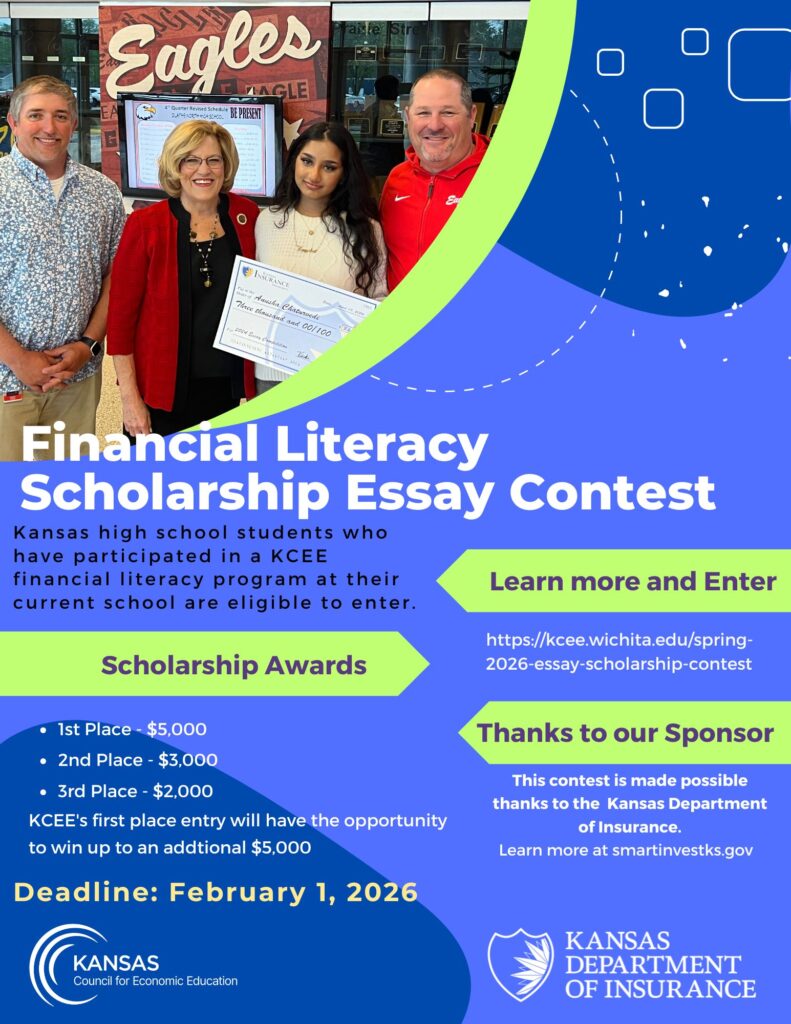
The Kansas Council for Economic Education is pleased to invite you, as a participant in one or more of the financial literacy activities sponsored by KCEE, to enter the 2026 Financial Literacy Scholarship Essay Contest sponsored by the Kansas Department of Insurance.
Contest Rules
Students participating in the contest must enter an essay that meets the following requirements:
- A maximum of 1500 words
- 12‐point font, double‐spaced, 1‐inch margins
- Must be submitted as plaintext
- Each entry must be done individually and independently, representing each student’s own research thinking and writing
Each student who submits an essay to the contest must be:
- a legal resident of Kansas in grade 9-12; and
- a participant in at least one of KCEE’s student programs (LifeSmarts, Kansas Economics Challenge, Kansas Personal Finance Challenge, The Stock Market Game).
To give other Kansas students an opportunity for scholarships, the winner of the statewide essay contest will not be eligible to compete in subsequent years.
Essay content is at the student’s discretion but must answer the question posed by the Kansas Department of Insurance. Students may discuss what they hope to implement in their own life from the lessons learned in the financial literacy courses provided by their organization as it pertains to the question posed.
The 2026 question is as follows:
One day, you are at your grandparents’ house, and they mention to you that they stumbled across an advertisement on social media from a well-known celebrity whom they identify with for a new cryptocurrency. This cryptocurrency is called BCDSCoin and is advertised as a brand-new cryptocurrency. Additionally, the advertisement also claimed to guarantee a 50% year over year return and urged investors to act quickly. After your grandparents show you the advertisement, they mention they want to put all their retirement savings into BCDSCoin for the guaranteed 50% return. They have been asked by an employee of BCDSCoin to withdraw their funds, put them into a cryptocurrency ATM machine and add their funds to the cryptocurrency wallet of the person they are investing with.
Is this a scam? If so, what type of scam is it and what are the red flags that would indicate a scam?
How would you handle this situation, where someone you know is in the process of being defrauded? How would you try to talk them out of this investment or at least get them to do their research before investing?
How would you report this scam and to what authority or authorities?
Consider these resources when conducting your research:
https://smartinvestks.gov & https://econedlink.com
Scoring:
The Essay will be scored using the following formula for a total of 55 points:
Identify the scam (15 points)
Student calls out the scam in the scenario and demonstrates knowledge of the red flags present.
Demonstrates a plan on how to approach someone in a scam (10 points)
Student provides a comprehensive plan on how to help someone faced with a scam, including techniques and overall knowledge.
Demonstrates a plan on how to report the fraud, using anti-fraud resources (15 points)
Student identifies proper authorities, and the information required to report the scam.
Overall demonstration of financial literacy (10 points)
Student demonstrates a strong understanding of financial literacy topics.
Grammar and spelling (5 points)
Student writes clearly and effectively, with few or no grammatical or spelling errors.
Scholarships:
The three students with the top three essays submitted by the Kansas Council on Economic Education will receive the following awards:
- First-place Essay – $5,000
- Second-place Essay – $3,000
- Third-place Essay – $2,000
The First-place essay will be automatically evaluated with essays submitted from other organizations to determine overall statewide scholarship awardees, with the same awards as those at the organizational level (i.e., $5,000 for the statewide first-place essay, $3,000 for the statewide second place essay, and $2,000 for the statewide third-place essay.
Scholarships will be awarded to a Kansas 529 account for use by the student as allowed by law.
Submissions to KCEE are required by Monday, February 2, 2026 and should be submitted via the online form below. It is the teacher’s responsibility to ensure essay entries have been received by KCEE.
Students must complete the form below and their teacher will submit the student’s essay in a separate form.
Financial Literacy Scholarship Essay – Student Entry Form
Contact Charlene Nichols at charlene.nichols@wichita.edu with any questions.